


Brand History
Every write-up in this section started as one item that showed up first. A jacket, a shirt, a cartridge, a poster. The history came after, because it turned out to matter.
Sixteen brands so far, sorted by what they actually are rather than alphabetically. Looking for the smaller names instead? Try Deep Cuts.
Streetwear & Skate
Anime & Manga
Gaming
Tips
Anime

Akira
Akira started as a manga, not a film. Katsuhiro Otomo began serializing it in 1982, building out a sprawling cyberpunk Neo-Tokyo years before the movie condensed the story down to a two-hour runtime. The 1988 film adaptation, which Otomo directed himself, is the version most people know, and it was, at the time, the most expensive anime film ever produced. That budget shows in ways that still hold up: the hand-drawn animation uses far more individual frames per second of motion than standard anime practice of the era, which is part of why the movement in Akira still looks unusually fluid decades later.
Akira didn't just influence anime. It's one of the direct visual ancestors of cyberpunk as a mainstream aesthetic, full stop. Neon-lit sprawl, biker gangs, corporate decay, body horror mixed with technology: a huge amount of what The Matrix, Stranger Things, and modern cyberpunk media borrow visually traces straight back to Akira's Neo-Tokyo.
The film also functioned as a lot of Western audiences' first real exposure to anime as a serious medium rather than kids' programming, landing in North America at a moment when almost nobody outside dedicated fan circles had a frame of reference for it.
Dig through what's in stock: Media
Cowboy Bebop
Cowboy Bebop takes its name from a jazz term on purpose. Bebop is the improvisational, boundary-breaking style of jazz pioneered by musicians like Charlie Parker and Dizzy Gillespie, and director Shinichiro Watanabe built the whole show around that same idea: a genre-blending mix of noir, western, science fiction, and slapstick comedy that refuses to sit still in one category, the same way bebop itself refused to sit still inside traditional jazz structure.
The soundtrack isn't set dressing, it's practically a co-lead. Composer Yoko Kanno formed an actual working band, The Seatbelts, specifically to score the series, and the music swings between hard bop, blues, and orchestral pieces episode to episode depending on the tone. Few anime scores are discussed as seriously as standalone music as Cowboy Bebop's.
It aired in Japan in 1998, but several episodes were pulled from the original broadcast over violent content and only aired later in an uncut run. The show's real breakout audience came in 2001, when Cartoon Network's Adult Swim block picked it up and introduced it to a huge English-speaking audience who'd never seen anime treated with that kind of cinematic seriousness on American television before.
Dig through what's in stock: Media
Dragon Ball
Dragon Ball started as Akira Toriyama's loose riff on Journey to the West, the classical Chinese novel about a monkey king on a pilgrimage, filtered through his own obsession with Bruce Lee and Jackie Chan films. Son Goku is a direct descendant of that monkey king archetype: a tail, superhuman strength, and a habit of getting into trouble he mostly punches his way out of. The manga began serialization in Weekly Shonen Jump in 1984.
The version most people actually picture when they hear the name, the Saiyans, Frieza, Cell, Buu, is technically the sequel. Dragon Ball Z began in 1989, once Toriyama shifted the story from martial arts adventure into the planet-cracking power scaling the franchise became famous for. That shift is also, by most accounts, what standardized the modern shonen power-up formula: training arcs, transformation forms, villains who keep escalating past the last one, a template a huge chunk of the genre still runs on.
Toriyama kept working on the franchise, in various forms, for the rest of his life. Few manga artists get to watch their first serialized work become a permanent fixture of global pop culture. Fewer still keep steering it for four decades.
Dig through what's in stock: Anime Merch · Cards
Naruto
Naruto began life as a one-shot, a single standalone short story Masashi Kishimoto submitted to a Weekly Shonen Jump talent contest, not a planned franchise. The concept leaned on Japanese folklore around the kitsune, the nine-tailed fox spirit, recast as something sealed inside a rejected, friendless kid instead of something to simply fear. That reframing, an outsider carrying a monster nobody chose for him, became the emotional engine for the entire eventual series.
The full manga launched in Weekly Shonen Jump in 1999 and ran for 15 years. Kishimoto has said in interviews that a lot of Naruto's isolation and desperation to be acknowledged came directly from his own early career, grinding through rejected pitches before Naruto ever got picked up. The character's arc mirrors the artist's, whether that was fully intentional or not.
What actually made Naruto a global phenomenon rather than just a hit in Japan was timing. It landed right as Toonami and early internet fansubbing were building an English-speaking anime audience hungry for exactly this kind of long-running shonen story, and Naruto rode that wave as hard as any series of its era.
Dig through what's in stock: Anime Merch
Neon Genesis Evangelion
Neon Genesis Evangelion looks like a mecha show and mostly isn't one. Director Hideaki Anno built Gainax's 1995 series on top of familiar giant-robot bones, a teenage pilot, monstrous enemies called Angels, a secret organization pulling the strings, then used that structure to dig into depression, isolation, and his own well-documented struggles with mental health during production. It's widely read as one of the more openly personal projects a director has put into a mainstream anime.
The ending is the part everyone actually argues about. Budget constraints and production strain in the final episodes forced Gainax into an abstract, low-animation, heavily introspective finish that alienated a large chunk of the existing audience. Anno responded, not by walking it back, but by making The End of Evangelion in 1997, a theatrical film that retells the ending with a very different, much more violent and explicit tone. Two canon endings exist for the same show, on purpose, and fans still debate which one actually counts.
Rei Ayanami and Asuka Langley Soryu became two of the most reproduced characters in anime merchandising history, which is directly why phone cards, carddass sets, figures, and graded trading cards featuring them are still such a dense, active collecting category three decades later. The show never stopped generating physical ephemera worth chasing.
Dig through what's in stock: Collected From Japan · Cards Graded Japan
SoftCel Pictures
SoftCel Pictures was A.D. Vision's adult label, launched in the early 1990s as ADV built out its mainstream anime distribution business alongside it. It wasn't the only company doing this. In the same window, Central Park Media ran a parallel adult imprint called Anime 18, and Media Blasters would later build its entire company around one, Kitty Media. Adult anime on VHS wasn't a fringe experiment in the 90s, it was close to a standard second division for almost every serious anime distributor operating in North America at the time.
That split existed for a practical reason. Mainstream anime distributors wanted shelf space in general video stores and needed clearly separated adult lines to keep retailers comfortable stocking both. SoftCel let ADV chase two audiences at once without either one contaminating the other's packaging or marketing.
Titles like Cool Devices became flagship SoftCel releases specifically because they delivered the animation quality ADV's mainstream catalog was known for, just aimed at an adult audience instead of a general one. As the anime market matured through the 2000s and physical media distribution shifted toward digital, dedicated adult labels like SoftCel became less central to how companies operated, and much of that VHS-era catalog now exists mostly as a physical collecting category rather than something currently in print.
Dig through what's in stock: VHS Japan
Kitty Media
Kitty Media launched in May 1997 as the adult label of Media Blasters, a company founded that same year by John Sirabella and Sam Liebowitz, both of whom had left Central Park Media the year before to start their own operation. It's a genuinely small, tight loop: two guys leave one anime distributor's adult-adjacent orbit and immediately go build a competing one under their own name.
What's actually notable about Kitty Media isn't when it started, it's how long it kept going. By most accounts it became the longest continuously active adult anime label in the American market, releasing titles for two full decades while plenty of competitors folded, merged, or quietly stopped putting out new content. Flagship releases like La Blue Girl, Bible Black, and Discipline built the label's reputation and stayed in circulation for years.
Kitty Media was sold to FAKKU in November 2017, closing out its run as a Media Blasters property and moving the catalog into digital-first distribution instead of the physical VHS and DVD releases that defined its first fifteen-plus years. The physical-era titles are exactly the ones that show up in resale now, and they're the ones actual collectors are after.
Dig through what's in stock: VHS Japan · Adult Japan
Brand History
Clothing

Hook-Ups Skateboards
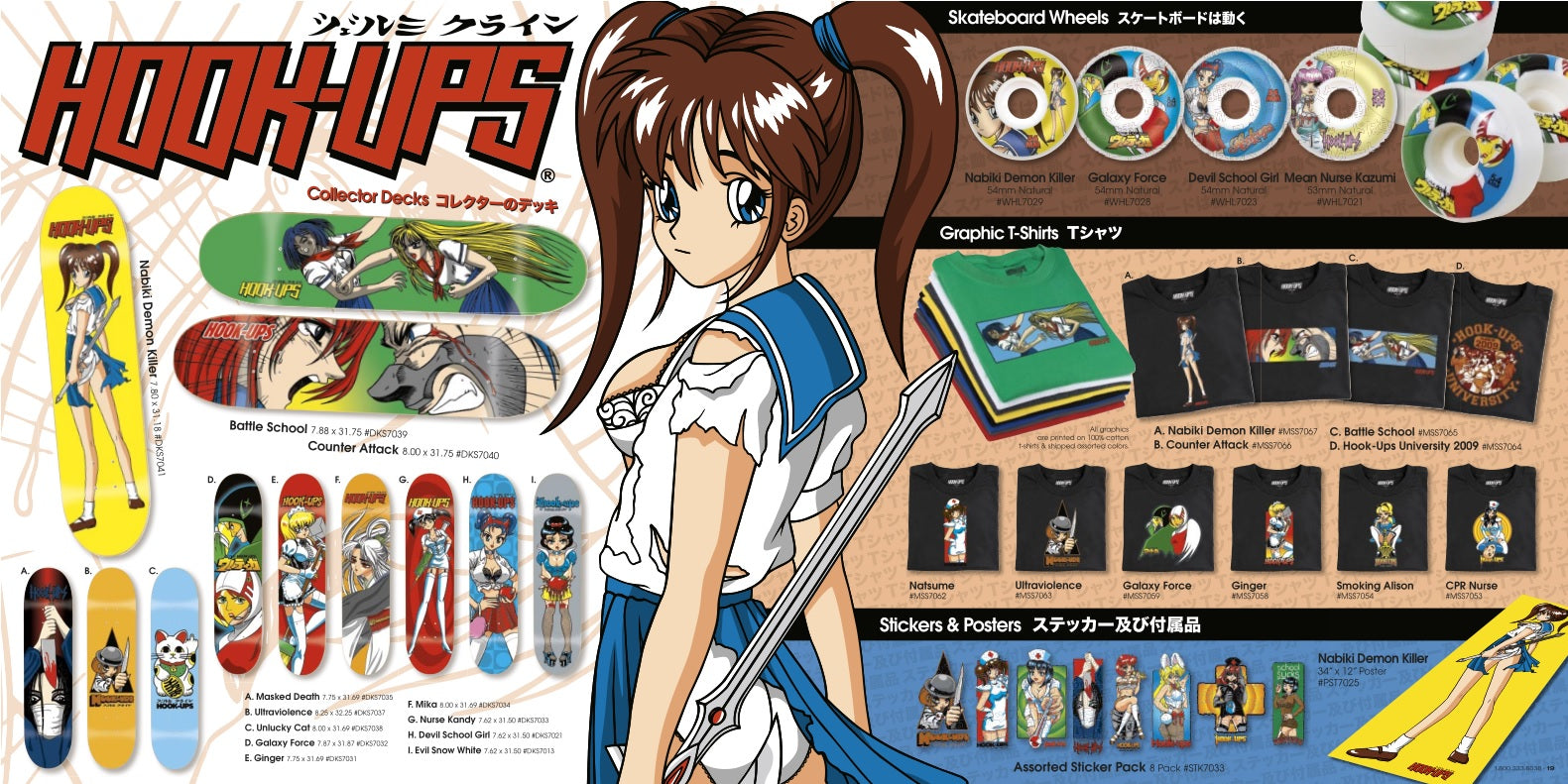
Hook-Ups started as t-shirts, not skateboards, in the summer of 1993. Jeremy Klein, already a pro skater who'd come up through World Industries and then Birdhouse under Tony Hawk, launched it under the Birdhouse Distributions umbrella alongside Flip. Printing shirts was simply easier and cheaper than producing decks, so that's where the brand actually began before the boards followed.
The anime graphics weren't a gimmick tacked on later, they were the entire point. Klein built the brand specifically to merge skate culture with his own fandom for Japanese animation, using stills and characters from anime series, often deliberately provocative ones, at a time when almost no other skate company was pulling from that well. Longtime Birdhouse artist Sean Cliver did a huge amount of the graphic work that made Hook-Ups instantly recognizable on a shelf full of other brands.
The best-selling Hook-Ups deck of all time, according to Klein himself, was the Alice in Wonderland graphic. And one of the wildest true stories from the brand's history: at the Japanese premiere of the Hook-Ups video The End, Klein and teammate Heath set themselves on fire as part of the promotion, which reportedly got the entire premiere shut down early.
Klein was pushed out of Birdhouse in 2008 during an ownership change, unrelated to Hook-Ups itself, and has run Hook-Ups independently and on a much smaller scale ever since. It's harder to find on shelves today, which is exactly why the 90s and early 2000s pieces are worth digging for.
Dig through what's in stock: Vintage T-Shirts
Levi's
Levi Strauss showed up in San Francisco in 1853 during the Gold Rush, selling dry goods, not pants. The jeans came from a Reno tailor named Jacob Davis, who kept blowing out the pockets on miners' work pants and started reinforcing the corners with copper rivets. He needed a business partner to patent the idea. He wrote to Strauss, who supplied denim to Davis's shop, and the two patented riveted work pants together in 1873. That patent date is the real birthday of the blue jean.
They weren't called jeans at first. The original name was "waist overalls," and they were workwear, full stop: built for miners, ranchers, and railroad crews who needed pants that wouldn't rip apart. The Red Tab, now one of the most recognized brand marks on earth, wasn't added until 1936, purely so cowboys could spot a genuine pair of Levi's from horseback at a distance.
The 501 didn't become a fashion statement until decades after it became a workwear standard. It took Hollywood, then the 1950s youth-rebellion look, then multiple waves of vintage revival, to turn a rivet patent into a permanent fixture of American style.
Vintage Levi's is one of the deepest rabbit holes in resale. Selvedge edges, redline stitching, tab font, the arcuate stitch pattern on the back pockets. All of it dates a pair, and all of it matters to the people who know what they're looking at.
Dig through what's in stock: Bottoms
Nike
Nike started as a side hustle. In 1964, University of Oregon track coach Bill Bowerman and one of his former runners, Phil Knight, put in $500 each and started Blue Ribbon Sports, a company that did nothing but import Onitsuka Tiger running shoes from Japan and sell them out of the trunk of Knight's car at track meets.
Bowerman never stopped tinkering with soles. The story goes he poured rubber into his wife's waffle iron trying to build a better tread, ruined the iron, and walked away with the pattern that became the Waffle Trainer. That shoe is part of what let Blue Ribbon Sports break away from Onitsuka and launch its own brand in 1971.
The name Nike, after the Greek goddess of victory, beat out "Dimension Six" by one vote in a company meeting. The Swoosh came from Carolyn Davidson, a graphic design student at Portland State, who was paid $35 for it. She got Nike stock years later, once the company could afford to say thank you properly.
"Just Do It" didn't show up until 1988, and the phrase is loosely tied to the reported last words of a convicted murderer facing a firing squad. Dark origin, world-conquering result.
Vintage Nike holds up as a real collecting category because it's honest. You can date a piece close to the year by Swoosh style, tag font, or box design. That's rarer than it sounds.
Dig through what's in stock: Footwear
Supreme
James Jebbia opened the first Supreme on Lafayette Street in New York City in 1994. It was a skate shop before it was anything else, small enough that skaters could ride their boards inside without knocking things over. That detail shaped the whole layout: open floor, no clutter, product on the walls instead of racks in the middle.
The box logo that's now worth more than the clothes it's printed on wasn't built from scratch. It's a direct lift of the style used by artist Barbara Kruger, who builds her own work around bold white-on-red Futura Bold Italic text overlaid on images. Supreme never pretended otherwise. Kruger reportedly wasn't thrilled, but never sued, and the logo became one of the most counterfeited marks in streetwear.
The drop model is the part that actually built the empire. Small weekly releases, on purpose, sold out on purpose, gone forever on purpose. That manufactured scarcity is the blueprint half of modern streetwear and sneaker culture is still copying.
Supreme spent its first decade as a niche skate brand almost nobody outside New York knew about. The Louis Vuitton collaboration in 2017, and a reported billion-dollar-plus valuation not long after, is what put it somewhere else entirely.
Dig through what's in stock: Tops · Vintage T-Shirts
Thrasher Magazine
Thrasher wasn't built to be a magazine first. It was built to sell trucks. Fausto Vitello and Eric Swenson had co-founded Independent Truck Company in 1978, and by 1981 they needed a way to promote it. Their solution was to start a skateboarding magazine and put their own product in front of the exact audience they wanted, with Kevin Thatcher brought on as the founding editor. The magazine's early newspaper-style format wasn't a design choice either. Fausto had a friend with a press set up for that paper size, so that's the size Thrasher launched in.
The motto, Skate and Destroy, wasn't invented by the magazine. It was already in use among skaters and punks in the 1970s, and Thrasher just adopted it as its own, which tells you a lot about the magazine's whole approach: document the culture that already exists instead of manufacturing one.
A detail almost nobody clocks: the Thrasher logo font is Banco, a display typeface designed by French type designer Roger Excoffon back in 1951, three decades before skateboarding ever used it. Both founders had rough ends, Swenson by suicide in 2011 after years of chronic pain from a motorcycle accident, Vitello from a heart attack while riding in the 2000s, but the magazine they built to sell trucks outlived both of them by a wide margin and is still the most recognized name in skate media.
Dig through what's in stock: Vintage T-Shirts
Denim
Denim is one of the only fabrics that's supposed to look used. Almost everything else in a closet is trying to hide wear. Raw denim is built to show it.
Selvedge is the word to know. Old shuttle looms weave denim in narrower strips and finish each edge cleanly on their own, no overlocking needed, which leaves a tight, self-finished band along the seam, usually in a colored thread. That clean edge is the actual, literal self-edge, which is where the word selvedge comes from. Cut open a pair of jeans at the outseam and you can see it directly.
Raw, unwashed denim fades based entirely on how the specific wearer moves. Whiskering at the hips, honeycombs behind the knees, fading along the wallet in a back pocket. No two pairs age the same way, which is the entire appeal to people who collect it seriously. Sanforized denim, pre-shrunk and treated at the factory, skips a lot of that character in exchange for predictability.
Japan built its own serious reputation in this space, particularly around Okayama, where mills still run vintage shuttle looms decades after most of the world moved to faster, wider modern looms. Slower production, tighter weave, and it shows in how the fabric ages.
A worn-in pair of raw denim is, unusually for secondhand clothing, often more valuable and more interesting than a fresh one. That alone makes denim one of the strangest and most rewarding categories in vintage.
Dig through what's in stock: Bottoms
Brand History
Toys
Hasbro
Lego
Mattel
Brand History
Video Games

Nintendo
Nintendo is older than the light bulb's mass adoption in most Japanese households. Fusajiro Yamauchi founded it in Kyoto in 1889, and the original product wasn't games in any modern sense. It was hanafuda, hand-painted Japanese playing cards used for a card game that dates back centuries. Nintendo has been in business for over 130 years, and spent the first 70 or so nowhere near a video game.
Between the card business and the console business, Nintendo tried on a lot of hats. Under the third president, Hiroshi Yamauchi, the company at various points ran a taxi company, a love hotel chain, a TV network venture, and an instant rice brand. Almost none of it worked. What did work, eventually, was toys, starting in the 1960s with things like the Ultra Hand extendable arm gadget, which nudged the company toward electronics and, by the late 1970s, arcade games.
The name itself is debated. One common reading ties it to leave luck to heaven, a fitting motto for a company that spent decades trying random businesses before finding the one that stuck.
Everything from the NES to the Switch traces back to a playing card company that refused to fold when card games stopped being a growth industry.
Dig through what's in stock: Video Games
Playstation
The PlayStation exists because Nintendo double-crossed Sony in front of the entire industry. In the early 90s, Sony and Nintendo were partners, building a CD-ROM add-on for the Super Nintendo called the SNES-CD. Sony had a working prototype and a real deal. Then, at the Consumer Electronics Show in 1991, Nintendo walked on stage and announced they were partnering with Philips instead, on the exact same category of product, blindsiding Sony publicly and killing the SNES-CD deal on the spot.
Sony didn't fold. Ken Kutaragi, the engineer who'd championed the partnership internally against a lot of skepticism at Sony, pushed to keep building anyway, just without Nintendo attached. What came out the other side was a standalone console instead of an add-on: the PlayStation, launched in Japan in December 1994 and in North America in September 1995.
It worked. Fast. The PlayStation became the first console to ship over 100 million units, dragged 3D gaming into the mainstream, and turned a spurned add-on project into the console line that's outlasted almost everything Nintendo threw at it since.
Dig through what's in stock: Video Games
Sega
Sega didn't start in Japan, and it didn't start as a game company. It started in 1940 in Honolulu, Hawaii, as Standard Games, a company that built coin-operated amusement machines for U.S. military bases. After the war it relocated to Tokyo and renamed itself Service Games, importing jukeboxes and slot machines to entertain American servicemen stationed there. Shorten Service Games and you get SEGA. That's the whole naming story, hiding in plain sight for decades.
Sega spent the 60s and 70s as an arcade hardware company, building coin-op cabinets and electro-mechanical games before video games existed in any recognizable form. Consoles came later, and always second: the Master System behind the NES, the Genesis fighting Nintendo directly and actually winning real ground in North America for a stretch, then the Saturn and Dreamcast losing that fight to Sony and Microsoft.
The Dreamcast is the part of the story people romanticize hardest. It launched features other consoles wouldn't touch for years, a built-in modem for online play chief among them, and still lost the generation. Sega left console hardware entirely after it, and became a third-party developer instead, the company that used to compete with PlayStation now making games for it.
Dig through what's in stock: Video Games
Xbox
Xbox exists because a handful of Microsoft engineers were worried Sony was about to turn the living room TV into a computer, and Microsoft would get locked out of it. In 1999, a small internal team, several of them former DirectX graphics engineers, pitched a games console built on PC architecture instead of the custom chips every other console used. The early codename was literally DirectX Box. Shortened, that's Xbox.
Bill Gates himself unveiled it at CES in January 2001, walking on stage alongside pro wrestlers, which tells you exactly how hard Microsoft was swinging to look like a games company and not a software company cosplaying as one. The console launched in North America that November, going head to head with the PlayStation 2 and Nintendo GameCube.
The original controller, nicknamed The Duke, was enormous, built for average American hand size data that turned out to be wrong for a lot of players, and got quietly redesigned smaller within a year. Halo, meanwhile, did what the hardware alone couldn't: it gave Xbox an actual reason to exist next to two console makers with decades of head start.
Dig through what's in stock: Video Games